Pop-Localization: AI for the Many, Artisans for the Few
Predicting the future is hard. Show me one person from 2010 who correctly predicted what exactly the world would look like in 2025, what end-to-end technologies we’d use, how we’d manage companies, what the political climate surrounding all this would be. Good luck. In 2010, we were less than a year into the existence of the “like” button on Facebook, Instagram launched in October, and the most powerful democracy in the world electing a Black president was a testament to how much we’ve achieved as humanity and a promise that everything was possible. No one in their wildest dreams could fully predict what 2025 would look like. So yeah, I don’t think anyone knows what the world and localization will look like in 5, 10, 15 years. But let's make some guesses regardless, take screenshots and let's chat in a decade.
To state the obvious, AI isn’t a whim, it’s here to stay. LLM-driven quality estimation? Agentic workflows integrating engineering with localization? Content operations rather than translation as an afterthought? That is all important and all true, but it’s happening now, not in the future. Talking about it is not a vision. Neither is talking about the rage against the machine, or about how the future lies in the wise collaboration between humans and tech.
So what is the vision? Pop-Localization. The exponential growth of AI will create mass localization beyond our comprehension. The widely accessible, instantly recognizable Beyoncés of international experience. Doing their job on an impressive level of quality, endurance and preparation, resonating with international audiences. However, the existence of Beyoncé doesn’t mean that the symphonic concerts disappear—or that the occasional pity-inducing lipsync flops are extinct.
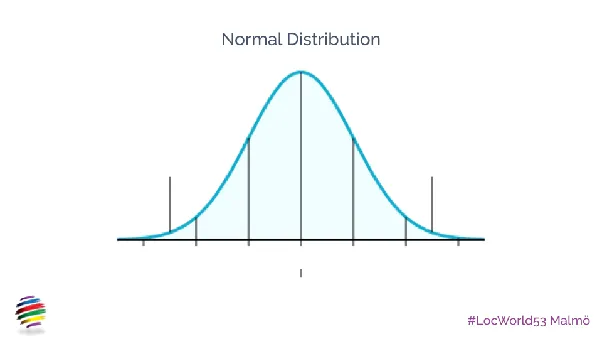
We all know the Gaussian normal distribution graph. The majority of just about anything is average. Things that are radically bad or incredibly good are fairly rare. That is true for human operations, in any area: whether we like it or not, we’re mostly… mediocre. We’re unassuming, forgettable, uncreative. Despite Linkedin bursting in its seams with the declarations of the groundbreaking, market-leading, and pioneering, we’re not that awesome. But hey, that’s good news! Because it means that in the future, AI will be able to automate the majority of whatever it is we’re doing, including localization operations. It won’t be too complex to orchestrate, the agents and algorithms will take care of it.
If we give AI enough prompts, context, benchmarks, we can create end-to-end content ecosystems, where the tone and voice will be adjusted to the type of content and target audience, and businesses will be more cost-efficient than ever. AI-generated content is already beyond impressive. And it’ll just keep getting better. We’ll ditch the bloated TMS platforms with irreproducible, vague, proprietary quality metrics. We’ll think bigger than segments, bigger than MTPE, bigger than just translation. We’ll be easily providing not just localized content, but individually curated international experience. This already is an evolution in progress.
The dark side of it? The elephant in the room? Yes, some people will lose their jobs. Those who refuse to be critical, thoroughly understand the tech, learn new skills and adapt their roles, will fizzle out and turn into bitter, obsolete relics of the past. Let’s remember though, that just because lamplighting isn’t a profession anymore, doesn’t mean that we don’t need people who orchestrate the street lights.
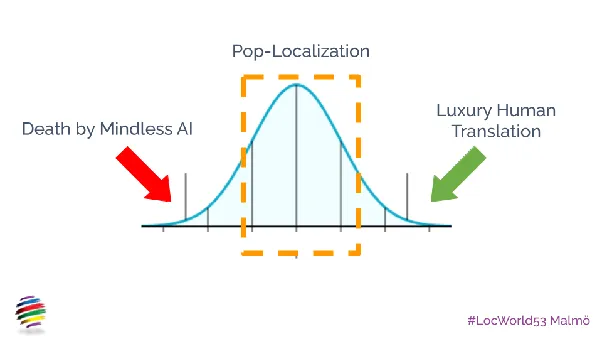
Ok so what about the two polar ends of the normal distribution chart? The really bad and the really good?
The really bad is the businesses who will use AI without a thought behind their eyes. Because AI won’t kill localization but lazy use of AI might. AI makes it easy to produce garbage at scale. Many companies will fall for that trap. They’ll shove everything into AI tools with no oversight, chasing speed and temporary savings. And the result? A race to the bottom — to generic, broken, tone-deaf content. Those businesses will alienate their global audiences and drive themselves into extinction.
And the really good? Super niche domains, low-resource languages, creative content. Areas where the human expertise will stay indispensable and invincible.
Like with farming, music or fashion, automation enables the production of the mass-appealing, “good enough” products at scale. Things that keep us fed, entertained, dressed, alive. Automation provides the acceptable average, maybe even surface-level excellent, but not the breathtaking quality that feels like we participate in something special. For incredible experiences, we have to go beyond supermarket meat aisles, stadium concerts, and fast fashion. Netflix doesn’t make inspirational shows about chain fast food restaurants and rotisserie chicken. It’s not what moves us. Does it mean that chain fast food is horrible or will disappear? No. And anyone who knows me, knows that I’m a big fan of rotisserie chicken. But I won’t go to a fast food joint if I want to feel something.
Human translation will become a luxury good. An equivalent of that restaurant where you booked a table three months in advance, because the head chef runs a behind-the-scenes research group documenting the edible herbs of the Peruvian plains. The linguists who are obsessed with their craft, nerdy, nurturing their niche interests, will become the curators of luxury. They’ll be the boutique organic farmers of international experience. Will they appeal to the mass audience? No. Will the mass audience be able to afford them? For the most part, no, and definitely not on a daily basis. But will they be a benchmark for excellence? I truly hope so.
So here’s my vision for the future of localization as the normal distribution curve:
- the majority of localization operations and content types will be automated by AI beyond the currently known TMS systems and quality metrics—that’s the Pop-Localization
- the businesses who push everything through AI without any critical thought will disappear because they’ll just produce garbage that attracts no one
- and the human translators who are exceptionally good at their niche domains will become luxury artisans, crafting boutique, ultra-high quality international experience.